General Maintenance Guidelines
The only required maintenance for the Diesel Particulate Filter is periodic cleaning of the filter section. Refer to “”Cleaning the Diesel Particulate Filter” ” for the correct cleaning procedure. All DPFs collect ash from lube oil during operation. This ash is not combustible. The buildup of ash will eventually cause an increase in back pressure. Perform a back pressure test in order to determine if the DPF needs to be cleaned. Refer to “”Testing the Diesel Particulate Filter” ” for the correct procedure for testing the back pressure. Maintenance intervals will vary depending on the application. The following items are factors that will affect the required maintenance interval:
- Idle Time: Excessive Idle time will rapidly plug the DPF with soot. Excessive amounts of soot can cause very high regeneration temperatures damaging the DPF.
- Fuel Composition: Use ONLY Ultra Low Sulfur Fuel. Other fuels will rapidly plug the DPF with Sulfate Ash generated from the fuel sulfur requiring more frequent DPF cleaning. Note: Biodiesel up to and including B20 is acceptable. Biodiesel greater than 20%, lube oil, or fuel additives blended into diesel fuel is not acceptable. Biodiesel fuels must comply with ASTM D6751 applicable for 15 ppm sulfur content.
- Exhaust Temperature: DPF inlet temperature MUST BE 240° C (464° F) or greater at least 40% of the time otherwise the DPF will plug with soot.
- Engine Emissions Level: Excessive fuel and oil burn will shorten the life and cleaning intervals of the DPF due to increased ash and soot generation.
- Oil Type: Low Ash Oil is recommended. Caterpillar low ash Diesel Engine Oil is recommended.
- Engine Condition: Poor or marginal oil control or excessive blow by will shorten maintenance intervals and DPF life.
- NOx to PM (Particulate Matter) Ratio: Must be at least 25:1 (this ratio is the NOx level divided by the PM level) for the DPF to regenerate properly at 240° C (464° F).
Diesel Particulate Filter Back pressure Testing
The DPF will become restricted with soot and ash from normal engine operation. The restriction will cause the exhaust back pressure to increase. Testing the back pressure of the exhaust system will determine when the filter section needs to be cleaned. Initial back pressure of a new unused DPF installation must be recorded and maintained on the table provided in “”Appendix B” ” for a baseline value. This initial back pressure is the basis for determining serviceability of the DPF after future cleaning. This information is critical and must be maintained for future use. The back pressure can be measured using the 423-5875 Clean Emissions Module and PC.
Exhaust back pressure must be tested:
- When a new unit is installed. The initial pressure must be recorded on “”Appendix B” ” as the initial back pressure. Recording the initial pressure is an important reference point and should not be omitted. Failure to observe this practice may affect the DPF/Diagnostic Module warranty.
Back pressure should be recorded:
- At recommended machine service intervals
- Every 6 months
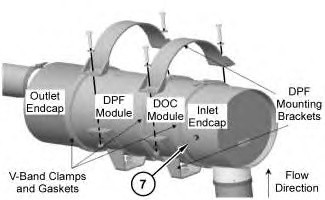
Note: Do not test the exhaust back pressure if the alarm for high pressure has been activated. Clean the DPF. Refer to “”Cleaning the Diesel Particulate Filter” ” for the correct cleaning procedure.
Back Pressure Testing Procedure with 423-5875 Clean Emissions Module
- Connect PC to 423-5875 Clean Emissions Module using 220-3778 Adapter Cable As . Start real-time display and monitor exhaust back pressure.
- Start the engine and run the engine in the no-load condition at high idle until the engine reaches normal operating temperature. Some publications call this condition Wide Open Throttle or W.O.T.
- Record back pressure on the chart provided in “”Appendix B” ” at every check. Recording the back pressure will help establish a trend to aid in anticipating when the DPF will need servicing. The results should never exceed 10 kPa (40 inch of H2O) on a filter that is in service. These back pressure tests should be taken at wide open throttle (rated speed) and no engine load. The back pressure on a newly cleaned filter must not exceed the original (new) installation back pressure by more than 25%. If this value is exceeded, reclean and measure the back pressure. Also refer to “”Appendix D” ” for further clean filter specifications.
- If at any time Diagnostic Module warning or alarm LEDs display, and are confirmed by the internal data log the DPF must be serviced immediately. See “Real-Time Display”.
- Record back pressure readings via Real-Time Display before and after DPF cleaning. Use “Record of Cleaning” in “”Appendix B” “.
Testing Back Pressure with Caterpillar Pressure Testing Groups
| Required Tools | ||
|---|---|---|
| Part Number | Part Name | Qty |
| 198-4240 or 1U-5470 |
Digital Pressure Indicator Gp (DEALER TOOL) or Engine Pressure Gp |
1 |
The back pressure can be measured with 198-4240 Digital Pressure Indicator Gp or the 1U-5470 Engine Pressure Gp .
Back pressure measurements are required when the following conditions exist:
- When a new unit is installed. The initial pressure must be recorded on “”Appendix B” ” as the initial back pressure. Recording the initial pressure is an important reference point and should not be omitted. Failure to observe this practice may affect the DPF/Diagnostic Module warranty.
- Every 6 months
- At recommended service intervals
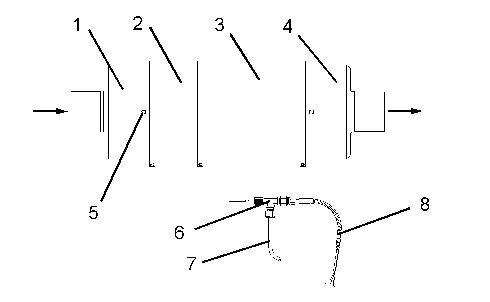
Illustration 69 g01032982
(1) Inlet section
(2) Catalyst section
(3) Filter section
(4) Outlet section
(5) Test port
(6) Tee fitting
(7) Copper tubing
(8) Thermocouple
Do not test the exhaust back pressure if the alarm for high pressure has been activated. Clean the DPF. Refer to “”Cleaning the Diesel Particulate Filter” ” for the correct cleaning procedure.
- Remove the tee fitting (6) from test port (5). Refer to Illustration 69.
- Connect the pressure port of the differential pressure gauge to the test port.
- Leave the vacuum port of the differential pressure gauge open to the atmosphere.Note: Watch the back pressure reading as the engine begins to warm up. Stop the test immediately if the back pressure goes above 10.2 kPa (41 inch of H2O) which is a definite indication that the filter must be cleaned. Refer to “”Cleaning the Diesel Particulate Filter” ” for the correct cleaning procedure.
- Start the engine and run the engine in the no-load condition at high idle until the engine reaches normal operating temperature.
- Record the value while the engine is operating at high idle.
- The results from Step 4 should never exceed 10 kPa (40 inch of H2O) at rated speed and no-load condition on a filter that is in service. The back pressure on a newly cleaned filter must not exceed the original (new) filter installations back pressure by more than 25%. If this value is exceeded reclean and measure the back pressure. Also refer to “”Appendix D” ” for further clean filter specifications. Refer to “”Cleaning the Diesel Particulate Filter” ” for the correct cleaning procedure.
Cleaning the Diesel Particulate Filter
Because the sections of the DPF are replaceable, a small stock of filter sections can be maintained. Filter sections from a small on hand stock can be used to replace filters in service at the next scheduled cleaning. The removed filters can be cleaned and returned for installation in the next vehicle. This process of maintaining a stock of filter sections can significantly reduce the amount of down time that will occur.
Note: Check State and Local air pollution regulations pertaining to record keeping of serviced filters. Some governmental entities may require filter tracking. Refer to “”Appendix B” ” for recommended record keeping.
Note: Perform a back pressure test prior to cleaning the DPF and record the results. After cleaning the DPF, run the engine at high idle for 5 to 15 minutes to bring the engine and exhaust system to operating temperature. Perform another back pressure test and record the results on the chart contained in “”Appendix B” “.
Recommended Cleaning Procedure
Caterpillar recommends the following process:
- Weigh and record the filter unit prior to baking
- Controlled baking of the filter unit (see following “Baking Procedure” section)
- Ash cleaning the filter unit using the 319-2189 Filter Cleaning Group
- Weigh and record the filter unit after controlled baking and pulsed air cleaning
- Reference “”Appendix B” ” for proper record keeping
Note: Cleaning DPF units without baking shortens the life the HEPA filters within the Cleaner. The result is a shortened ash service interval because of incomplete soot removal.
Baking Procedure
This procedure will burn off the remaining soot on the DPF leaving a smaller quantity of ash by baking the filter under controlled circumstances. Failure to observe this procedure can result to damage or cracking to the DPF substrate. A commercial programmable oven is required for this procedure. Careful adherence to this procedure is imperative. Deviation from this procedure may lead to thermal shock and cracking of the DPF substrate or melting at high temperatures.
- Place filter into a programmable commercial oven designed for this purpose. Centered as much as possible on a rack with 2 inches of spacing below and above for best results.
- Program the oven as follows:
- Ramp oven temperature to 200° C (392° F) over 20 minutes.
- Hold oven temperature at 200° C (392° F) for 120 minutes (2 hours).
- Ramp oven temperature to 450° C (842° F) over 30 minutes (.5 hours).
- Hold oven temperature at 450° C (842° F) for 120 minutes (2 hours).
- Cool down to ambient temperature at natural rate within the oven with the doors closed. Do not use fans.
- Place filter in cleaning machine and clean as per machine instructions.
- Replace the filter in oven. Ramp temp to 650° C (1202° F) in 60 minutes (1 hour).
- Hold oven temperature at 650° C (1202° F) for 240 minutes (4 hours).
- Cool to ambient temperature at a natural rate. Do not use fans.Note: Allow the filter to cool in the oven with the door closed until the filter can be handled with bare hands.