DPF General Installation Guidelines
This Section provides general mounting guidelines applicable to most DPF installations. Contact your Caterpillar Dealer Technical Communicator if you have questions for your particular installation.
DPF Registration
State and Federal regulations require registration information be recorded by manufacturer, installer, and customer. State and local regulations may vary, check local agencies for regulatory compliance. This form can be found on the Caterpillar Emission Solutions web site. The form must be completed on-line and registered with Caterpillar to activate the DPF warranty. For questions or concerns regarding the DPF call the Help Line at:
Cat Help 877-CAT-0909
The web address is:
https://dealer.cat.com/cda/layout?m=20019&x=7
Below are approved labels on Caterpillar DPF’s that comply with Federal regulation requirements. These labels must be displayed as depicted to avoid violation of the regulations and consequent penalties.
DPF Labeling Requirements
DPF labeling specifications are required by law in some localities, and required by Caterpillar for warranty purposes. The following labels are supplied with the DPF Assembly:
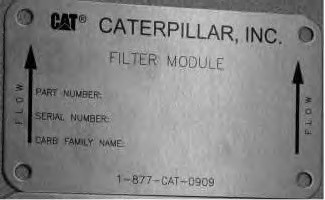
- The DPF Module and the DOC Module have different serial numbers. The serial number on the Engine Label matches the serial number on the DOC Module.
- Install the DOC Module and the DPF Module (rotate the modules) so labels are visible from a service area whenever possible.
- The Engine Label must be attached to the engine. Find a non-structural M8 bolt hole on the engine in a location that is visible from the service area. Use the bolt hole to secure the Engine Label. This label must remain attached to the engine and IS MANDATORY FOR REGULATORY COMPLIANCE.
The web address for Caterpillar DPF registration is:
https://dealer.cat.com/cda/layout?m=20019&x=7
The registration form can be filled out on-line and submitted directly to Caterpillar.
DPF Assembly Nomenclature and Parts
The Caterpillar Diesel Particulate Filter (DPF) Assembly (refer to Illustration 65) is a modular system consisting of:
| DPF Assembly Nomenclature and Parts | ||
|---|---|---|
| Item | Description | Qty per DPF Assembly |
| 1 | Inlet Endcap | 1 |
| 2 | Diesel Oxidation Catalyst (DOC) Module | 1 |
| 3 | Diesel Particulate Filter (DPF) Module | 1 |
| 4 | Outlet Endcap | 1 |
| 5 | Module V-Band Clamps | 3 |
| 5 | Module Gaskets | 3 |
| 6 | DPF Assembly Mounting Brackets | 2 |
| Not Shown | Diagnostic Module | 1 |
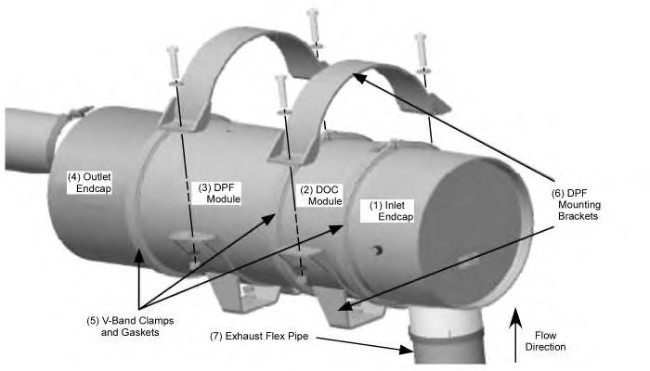
To create a robust installation, several elements must be applied properly. Refer to Illustration 65.
- Do not allow the DPF assembly to vibrate with both the engine and the chassis. Do not attach the DPF system rigidly to both the engine and the chassis. Exposing the DPF assembly simultaneously to both engine and chassis vibrations will cause failures. Isolate the DPF inlet from engine/chassis vibrations with 5N-4742 Exhaust Flex Pipe (7), Illustration 65.
- If the DPF is mounted rigidly to the engine, isolate the outlet from engine/chassis vibrations by using Flex Pipe. All cut ends of flex piping must be welded to prevent uncoiling after cutting. Note: Flex pipe length should not be less than 305 mm (12 inch).
- The DPF will support a 127 mm (5 inch) exhaust outlet pipe that has a maximum weight of 7.7 kg (17 lb) and a maximum bending moment of 65 N·m (48 lb ft). Stresses in excess of these may cause mechanical failure of the DPF exhaust pipe structure.
- Flex Pipe must be straight and must not be used for misalignment between the engine and DPF system. Improper alignment will cause component breakage.
- Support Brackets used between the DPF Mounting Brackets and machine must be designed with sufficient strength to support the weight of the DPF securely. Support Brackets used between the DPF Mounting Brackets and machine must also withstand the machine vibrations. Main support brackets must be mounted as far apart as possible on the center modules (DPF and DOC modules) as shown in Illustration 65. Main support brackets MUST NOT be mounted on either of the Inlet or Outlet endcaps. Doing so WILL cause the DPF to fail.
- The Exhaust Outlet Tailpipe must be oriented in a safe direction and must prevent water penetration into the DPF.
SAFETY Considerations
- Do not modify the machine Roll Over Protection System (ROPS) or other safety systems. Do not drill any holes or weld on ROPS. Refer to Special Instruction, SEHS6929, “Inspection, Maintenance and Repair of Rollover Protective Structures (ROPS) and Attachment Installation Guidelines” for further information.
- Operator safety considerations:
- Exhaust should be directed away from the operator.
- Avoid impairing operator visibility. Comply with visibility guidelines that are applicable to the locale.
- Protect areas that the operator may come in contact with, such as handrails and handles.
- Protect heat-sensitive components such as fuel lines, hydraulic lines, and electronics.
- Do not remove catalyst or DPF substrates or matting material from the metal housing.
- Diesel Particulate Filter assemblies can be greater than 45 kg (100 lb). Use appropriate lifting techniques to move hardware safely.
- Direct impacts to DPF internal components, especially the catalyst, and filter modules can cause non-warrantable damage.
DPF Orientation Guidelines
- The DPF may be mounted in nearly any orientation, most common are with the DPF assembly to be either horizontal or vertical. Do not install the DPF where the DPF would infringe access/egress points to the cab or interfere with vehicle service.
- Wheeled machine applications can be mounted in any orientation.
- Tracked machine applications typically have higher vibration loads than wheeled applications. Mounting the DPF in a horizontal position is recommended to prevent catalyst slippage within the can. Isolating engine and chassis vibrations in tracked machine applications is especially important.
- Water must not come in contact with the DPF internal components, because doing so may cause non-warrantable damage.
- If the DPF assembly and the exhaust outlet stack are both vertical, the DPF assembly must use a rain trap outlet end cap, available from Caterpillar.
- The orientation of the outlet stack could allow water to penetrate into the DPF assembly. If the outlet stack is oriented in a manner that might allow water to penetrate, insert a drain hole. The drain hole should be at least 1/4 inch diameter and located at the bottom of the outlet end (lowest point downward). A rain cap must be used. Refer to Table 13.
Table 13 Rain Cap Assemblies Outlet Stack Diameter Part Number Description 4 inch 7S-4994 Rain Cap As 5 inch 9S-7148 Rain Cap As 198-7424 Rain Cap As
DPF Placement Guidelines
- DPF’s replace the existing muffler and are typically located in the same place as the original muffler.
- Do not modify or interfere with the Roll Over Protection System (ROPS) or other safety systems.
- Do not attach the DPF system rigidly to both the engine and the chassis. Exposing the DPF assembly simultaneously to both engine and chassis vibrations will cause failures. Installing the DPF assembly rigidly to the chassis/frame and isolate the engine vibrations is recommended. In tracked machine applications, chassis vibration isolation is also recommended.
- Minimize the distance between the engine and DPF. DPF regeneration capability is dependent on the exhaust temperature at the DPF inlet side (minimum conditions at the inlet: 240° C (464° F) for 40% run time).
- The DPF mounting brackets should only be attached to either the machine structure (for example, frame) or the engine, not both. If necessary, additional support structure may be fabricated in order to create a rigid structure.
DPF Support Structure Guidelines
A typical DPF assembly weighs in excess of 45 kg (100 lb). Always use appropriate lifting techniques to move the hardware safely. The DPF must be supported to the machine adequately to prevent failures.
- DPF assembly mounting brackets (available from Caterpillar) must be used to support the DOC and DPF modules.
- Do not use the mounting brackets on the Inlet and Outlet end caps. Doing so will cause the end cap-DPF/DOC joint to fail.
- Attach the DPF assembly mounting brackets directly to the machine structure (frame) or mount to the engine.
-
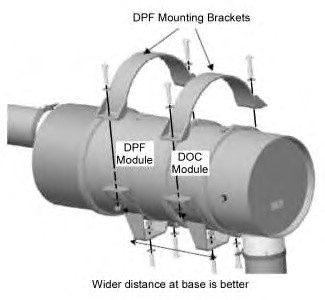
- Install the mounting brackets with the widest spread possible between the brackets. Refer to Illustration 66.
- Strengthen as needed to account for the increased weight. For example, replace existing muffler mounting plates or bracing areas of the machine not originally designed to accommodate the DPF weight.
- If attaching the DPF assembly mounting brackets directly to the machine structure (frame) is not possible, fabricate a support structure. Fabricate the support structure to interface between the DPF assembly mounting brackets and the machine frame.
- Design the support structure to work with the TWO DPF assembly mounting brackets.
- Design support structure to utilize all mounting bracket holes.
- Fabricate support structure using a minimum thickness of 10 mm (0.34 inch) low carbon steel so the loads will be shared between the mounting bracket and the support structure.
-
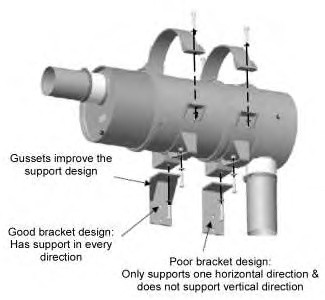
- Support structure must be able to support load in all directions. Refer to Illustration 67.
- Longer gussets will support more load. Refer to Illustration 67.
DPF Bolt Torque
The following specified fasteners and torque must be used:
- Mounting bracket bolts
- M12 bolts of appropriate length. Torque 100 ± 10 N·m (75 ± 15 lb ft)
- V-Band Clamps (to join DPF sections) Torque 16 ± 1 N·m (12 ± 1 lb ft)
- DPF Body Clamps
- M12 bolts of appropriate length. Torque 40 ± 5 N·m (30 ± 4 lb ft)
Note: All bolts and associated fasteners must be zinc plated. Phosphate coated fasteners are not acceptable.
Note: Applying more than the specified torque to the DPF body clamps may damage the filter assembly and affect the warranty.
Insulation Guidelines
- The DPF and DOC modules are internally insulated. Do not use external insulation on the DOC or DPF modules since external insulation may damage internal components from excessive heat retention.
- If additional thermal protection is required due to DPF location, use heat shields with an air gap.
- DPF operation is exhaust temperature dependent and machine loading should be relied upon to generate sufficient temperatures (minimum conditions at DPF inlet: 240° C (464° F) for 40% run time). Exhaust tubing may be insulated from the turbocharger to the DPF Inlet end cap to assist with control of under hood temperature, component protection considerations and low ambient temperatures. Insulation should not be relied on to correct temperature deficiencies due to light-duty cycle or excessive exhaust tube length. However, exhaust insulation may be of assistance to lessen the effects of heat losses. Any insulation installed must be thermal fireproof insulation. Insulation tape or cloth is not acceptable.
- For under-the-hood installations where the original piping layout has been changed, insulation may help to protect electrical, hydraulic, fuel, and other heat-sensitive components.
- Insulation may be used on the solid exhaust pipe. However, insulation should not be installed over exhaust flex pipe.