HEUI Fuel Injector (Operation)
The HEUI injector operates with a split injection cycle. The split injection cycle has five phases of injection:
- Pre-injection
- Pilot injection
- Injection delay
- Main injection
- Fill
Pre-Injection
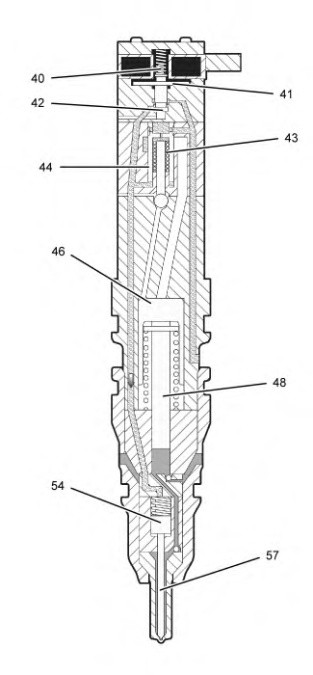
Cross section of pre-injection cycle
(40) Armature spring
(41) Armature
(42) Seated pin
(43) Spool spring
(44) Spool valve
(46) Intensifier piston
(48) Plunger
(54) Check piston
(57) Nozzle check
Refer to Illustration 9. The injector is in the phase of pre-injection when the engine is running and the injector is between firing cycles. Plunger (48) and the intensifier piston (46) are at the top of the piston bore. The cavity below the plunger is full of fuel.
In the upper end, the armature (41) and the seated pin (4) are held down by the armature spring (40). High pressure actuation oil flows into the injector. The oil then flows around the seated pin to the top of the check piston (54). This provides a positive downward force on the nozzle check (57) at all times when fuel is not being injected.
The spool valve (44) is held in the top of the bore for the spool valve by the spool spring (43). In this position, the spool valve blocks actuation oil from reaching the intensifier piston. Actuation pressure is felt on both the top and bottom of the spool, so hydraulic forces on the spool are balanced. The spool valve is held in the up position or the closed position by the force of the spool spring.
Pilot Injection
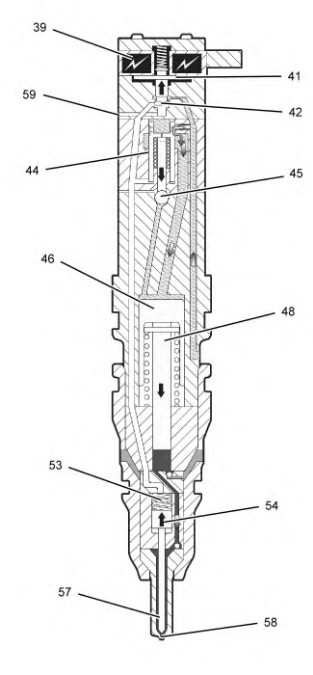
Cross section of pilot injection cycle
(39) Solenoid
(41) Armature
(42) Seated pin
(44) Spool valve
(45) Check ball for intensifier piston
(46) Intensifier piston
(48) Plunger
(53) Nozzle spring
(54) Check piston
(57) Nozzle check
(58) Nozzle tip
(59) Drain
Refer to Illustration 10. Pilot injection occurs when the ECM sends a control current to the solenoid (39). The current creates a magnetic field which lifts the armature (41) and the seated pin (42). The seated pin has a lower seat and an upper seat. When the seated pin is lifted by the armature, the upper seat closes off the flow of actuation pressure to the check. The lower seat opens. This allows the actuation oil on top of check piston (54) to flow to drain (59). Actuation oil that is trapped below spool (44) will also flow to drain (59). The actuation oil drains through a vent hole in the side of the injector.
The drop in pressure under the spool causes a hydraulic difference that acts on the spool. The spool moves into the open position when hydraulic pressure acts on the top of the spool. This hydraulic pressure forces the spool downward. The downward movement of the spool is stopped when the spool and the pin force the check ball (45) for the intensifier piston onto the ball seat in the closed position. This prevents any actuation pressure from escaping from the cavity for the intensifier piston (46). This drop in the actuation pressure also removes the downward force on the check piston.
Actuation oil now flows past the open spool and to the top of the intensifier piston. The downward movement of the piston and plunger (48) pressurizes the fuel in the plunger cavity to the nozzle tip (58). Pilot injection begins when the injection pressure increases in order to overcome the force of the nozzle spring (53) which lifts the nozzle check (57) .
Pilot injection will continue if the following conditions exist:
- The solenoid is energized.
- The spool remains open.
- There is no actuation pressure on top of the check piston.
Injection Delay
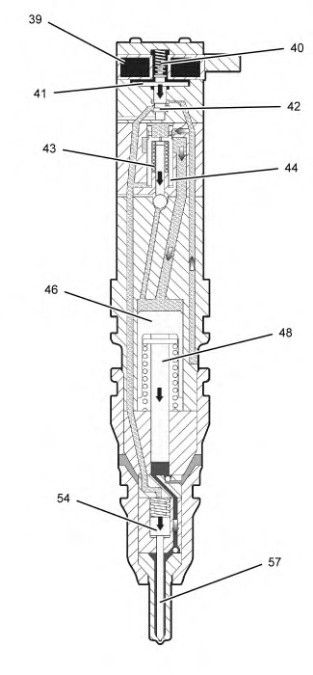
Cross section of injection delay
(39) Solenoid
(40) Armature spring
(41) Armature
(42) Seated pin
(43) Spool spring
(44) Spool valve
(46) Intensifier piston
(48) Plunger
(54) Check piston
(57) Nozzle check
Refer to Illustration 11. Injection delay begins when the control current to the solenoid (39) stops and the solenoid is de-energized. The armature (41) is held in the up position by a magnetic field. When the magnetic field is de-energized, the armature spring (40) pushes the armature and the seated pin (42) downward. The seated pin closes the lower seat and the seated pin opens the upper seat. This allows the actuation pressure to flow to the top of the check piston (16). The hydraulic force on the check piston quickly overcomes the injection pressure and the nozzle check (57) closes. Injection stops at this point.
Actuation pressure increases under the spool valve (44) that creates the balance of hydraulic force on the top and bottom of the spool. The weak spool spring (43) now acts on the spool. This closes the spool very slowly. As the spool remains open, actuation pressure continues to flow past the spool to intensifier piston (46) and to plunger (48). The injection pressure in the nozzle and in the plunger cavity increases very quickly when the nozzle check is held in the closed position.
Can C9 engine and C7 ues the same turbo?