HEUI Fuel System Operation
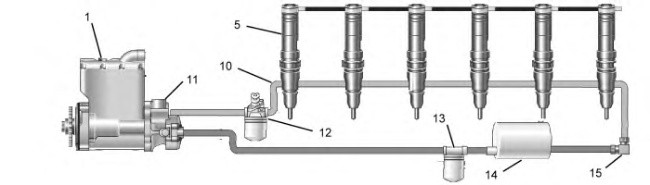
(1) Unit injector hydraulic pump
(5) Injectors
(10) Fuel supply passage
(11) Fuel transfer pump
(12) Secondary fuel filter
(13) Primary fuel filter/water separator
(14) Fuel tank
(15) Fuel pressure regulator
Low Pressure Fuel System
The low pressure fuel system serves three functions. The low pressure fuel system supplies fuel for combustion to injectors (5). Also, the low pressure fuel system supplies excess fuel flow in order to cool the unit injectors and the low pressure fuel system supplies excess fuel flow in order to remove air from the system.
The low pressure fuel system consists of four basic components:
- Fuel tank (14)
- Primary fuel filter/water separator (13)
- Two micron secondary fuel filter (12)
- Fuel transfer pump (11)
- Fuel pressure regulator (15)
Fuel transfer pump (11) is mounted on the back of unit injector hydraulic pump (1) .
Fuel is drawn from fuel tank (14) and flows through a thirteen micron fuel filter/water separator (13). The primary fuel filter/water separator removes large debris from the fuel. The debris may have entered the fuel tank during fueling. The debris may have also entered the fuel tank through the vent for the fuel tank. The primary filter element also separates water from the fuel. The water is collected in the bowl at the bottom of the primary fuel filter/water separator.
Fuel flows from fuel filter (12) to the inlet side of fuel transfer pump (11). An inlet check valve in the inlet port of the fuel transfer pump opens in order to allow the flow of fuel into the pump. After the fuel flow has stopped, the inlet check valve closes in order to prevent fuel flow out of the inlet port. Fuel flows from the inlet port in the pump to the outlet port, which also has a check valve. The outlet check valve opens in order to allow pressurized fuel flow out of the pump. The outlet check valve closes in order to prevent pressurized fuel leakage back through the pump.
Fuel flows from the outlet port of fuel transfer pump (11) to the fuel supply passage in the cylinder head. The fuel supply passage is a drilled hole which begins at the front of the cylinder head. The fuel supply passage extends to the back of the cylinder head. This passage connects with each unit injector bore in order to supply fuel to unit injectors (5). Fuel from the transfer pump flows through the cylinder head to all of the unit injectors. Excess fuel flows out of the back of the cylinder head. After the excess flows out of the back of the cylinder head, the fuel flows into fuel pressure regulator (15) .
Fuel pressure regulator (15) consists of an orifice and a check valve that is spring loaded. The orifice is a flow restriction that pressurizes the supply fuel. The check valve that is spring loaded opens at 35 kPa (5 psi) in order to allow the fuel which has flowed through the orifice to return to fuel tank (14). When the engine is off and no fuel pressure is present, the check valve that is spring loaded closes. The check valve that is spring loaded closes in order to prevent the fuel in the cylinder head from draining back to the fuel tank.
Injection Actuation System
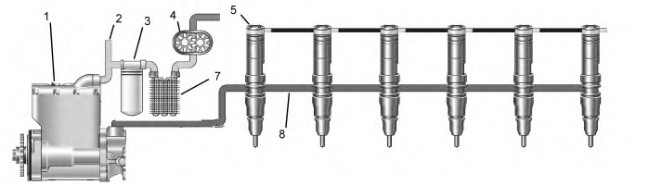
(1) Unit injector hydraulic pump
(2) Oil flow
(3) Oil filter
(4) Engine oil pump
(5) Injectors
(7) Oil cooler
Actuation Oil Flow
The injection actuation system serves two functions. The injection actuation system supplies high pressure oil in order to power HEUI injectors (5). Also, the injection actuation system controls the injection pressure that is produced by the unit injectors by changing the actuation pressure of the oil.
The injection actuation system consists of four basic components:
- Engine oil pump (4)
- Engine oil filter (3)
- Unit injector hydraulic pump (1)
- Injection Actuation Pressure sensor (9)
Oil from engine oil pump (4) supplies the needs of the engine lubrication system. Also, oil from the engine oil pump supplies the needs of unit injector hydraulic pump (1) for the fuel system. The capacity of the engine oil pump has been increased in order to meet the additional flow requirement that is necessary.
Oil that is drawn from the sump is pressurized to the lubrication system oil pressure by engine oil pump (4). Oil flows from the engine oil pump through engine oil cooler (7), through engine oil filter (3), and then to the main oil gallery. A separate circuit from the main oil gallery directs a portion of the lubrication oil in order to supply the unit injector hydraulic pump (1). A steel tube on the left side of the engine connects the main oil gallery with the inlet port of the unit injector hydraulic pump.
Oil flows into the inlet port of unit injector hydraulic pump (1) and the oil fills the pump reservoir. The pump reservoir provides oil to the unit injector hydraulic pump during start-up. Also, the pump reservoir provides oil to the unit injector hydraulic pump until the engine oil pump can increase pressure.
The pump reservoir also provides makeup oil to the high pressure oil passage in the cylinder head. When the engine is off and the engine cools down, the oil shrinks. A check valve in the pump allows oil to be drawn from the pump reservoir in order to keep the high pressure oil passage full.
Oil from the pump reservoir is pressurized in the unit injector hydraulic pump (1). The oil is then pushed out of the outlet port of the pump under high pressure. Oil then flows from the outlet port of the unit injector hydraulic pump to the high pressure oil passage in the cylinder head.
The high pressure oil passage connects with each unit injector bore in order to supply high pressure actuation oil to the unit injectors (5). Actuation oil that is under high pressure flows from unit injector hydraulic pump (1) through the cylinder head to all of the injectors. Oil is contained in the high pressure oil passage until the oil is used by the unit injectors. Oil that has been exhausted by the unit injectors is expelled under the valve covers. This oil returns to the crankcase through the oil drain holes in the cylinder head.
Can C9 engine and C7 ues the same turbo?