Active Diagnostic Code – An Active Diagnostic Code describes a condition that is currently present in order to alert the operator or the service technician of an abnormal parameter of engine operation. Refer to a Diagnostic Fault Code.
Aftermarket Device – An aftermarket device is a device or an accessory that is installed by the customer after the engine is delivered.
Air-To-Air Aftercooler – An air-to-air aftercooler is a device that is used on turbocharged engines in order to cool inlet air that has undergone compression. The inlet air is cooled after the inlet air passes through the turbocharger. The inlet air is passed through an aftercooler (heat exchanger) that uses ambient air for cooling. The inlet air that has been cooled advances to the inlet manifold.
Alternating Current (AC) – Alternating Current is an electric current that reverses direction at a regular interval that is reoccurring.
American Wire Gauge (AWG) – AWG is a measure of the diameter of electrical wire. AWG is also a measure of the current carrying capacity of electrical wire. When the AWG number is smaller, the diameter of the wire is larger. When the AWG number is larger, the diameter of the wire is smaller.
Analog Sensors – Analog sensors produce a DC output signal. The sensors are used in order to detect a change in temperature or pressure. The change is converted by the sensor to an electrical signal.
Analog Sensor Return – The common line (ground) for the analog sensor from the ECM is used as a ground for the analog sensors.
Analog Sensor Supply – The +5 VDC supply from the ECM is used in order to power the analog sensors.
Atmospheric Pressure Sensor – The atmospheric pressure sensor measures barometric pressure. The sensor sends a signal to the electronic control module (ECM). The signal is used in engine control and in engine operation.
Auxiliary Pressure Sensor – This sensor is an additional pressure sensor that is installed by the engine owner.
Auxiliary Temperature Sensor – This sensor is an additional temperature sensor that is installed by the engine owner.
Before Top Center (BTC) – BTC is the 180 degrees of crankshaft rotation before the piston reaches the top center position in the normal direction of rotation.
Boost – The difference between the turbocharger outlet pressure and the atmospheric pressure is commonly referred to as boost.
Boost Pressure Sensor – The boost pressure sensor measures inlet manifold air pressure. The boost pressure sensor sends a signal to the Electronic Control Module (ECM).
Bypass Circuit – A bypass circuit is a circuit that is used as a substitute circuit for an existing circuit. A bypass circuit is typically used as a test circuit.
Calibration – Calibration is an electronic adjustment of a sensor signal.
Camshaft Position Sensor – The camshaft position sensor measures the camshaft position, the direction of rotation, and the engine speed. The sensor sends the signals to the ECM. The term “Engine Speed/Timing sensor (camshaft)” will be used for the remainder of this publication.
CAT Data Link (CDL) – The CAT Data Link (CDL) is a serial communications system that is used for communication with other microprocessor based devices. The CDL is a proprietary Data Link that is used for Caterpillar equipment. The panel for the electronic monitoring system utilizes the CDL for communication. The CDL is also used for communication with ET.
Code – Refer to the Diagnostic Fault Code and the Diagnostic Event Code.
Cold Mode – Cold mode is a mode for cold starting and for cold engine operation that includes timing that is retarded and low idle that is raised. This mode is used for engine protection, reduced smoke emissions and faster warm up time.
Component Identifier (CID) – The CID is a number that identifies the specific component of the electronic control system that has experienced a diagnostic code. This is part of the CDL.
Communication Adapter Tool – The communication adapter provides a communication link between the ECM and an Electronic Service Tool.
Control Area Network (CAN) Data Link – The CAN Data Link is a serial communications port that is used for communication with other microprocessor based devices. The CAN data link is a standard in reference to J1939.
Coolant Level Sensor – This OEM installed sensor detects the absence or presence of coolant at the probe. The sensor then sends a signal to the ECM.
Coolant Temperature Sensor – This sensor detects the engine coolant temperature for Cold Mode operation and the Programmable Monitoring System. The Programmable Monitoring System must be enabled for the coolant temperature sensor to be used for monitoring purposes.
Crankshaft Position Sensor – The crankshaft position sensor measures the crankshaft position, the direction of rotation, and the engine speed. The sensor sends the signals to the ECM. The term “Engine Speed/Timing sensor (crankshaft)” will be used for the remainder of this publication.
Customer Specified Parameter – A Customer Specified Parameter is a value that can be set and changed by the customer. The parameters can be protected by Customer Passwords.
Desired Engine Speed – The desired engine speed is input to the electronic governor within the ECM. The electronic governor uses the signal from the Throttle Position Sensor, the Engine Speed Sensor, and the Customer Parameters in order to determine desired speed.
Diagnostic Event Code – These codes indicate an event that describes an abnormal engine condition such as a High Coolant Temperature. These codes are not necessarily an indication of problems within the Electronic System.
Diagnostic Fault Code – A Diagnostic Fault Code is sometimes referred to as a “fault code”. These codes indicate an electronic system malfunction or abnormal operating conditions.
Diagnostic Flash Code – The Diagnostic Flash Codes are flashed on the Diagnostic Lamp. These flash codes indicate a malfunction in the electronic system or an event that is detected by the ECM.
Diagnostic Lamp – The diagnostic lamp is used to warn the operator of the presence of an active diagnostic code.
Digital Sensors – Digital sensors produce an ON or OFF type of signal. Some sensors vary the ON or OFF time which is referred to as PWM Pulse Width Modulated.
Digital Sensor Return – The common line (ground) from the ECM is used as a ground for the digital sensors.
Digital Sensor Supply – The supply from the ECM is used in order to power the digital sensors.
Direct Current (DC) – Direct current is the type of current that flows consistently in only one direction.
DT, DT Connector, or Deutsch DT – This is a type of connector that is used on CAT machines and truck engines. The connectors are manufactured by Deutsch.
Duty Cycle – Refer to Pulse Width Modulation.
Electronic Control Module (ECM) – The ECM is the engine’s control computer. The ECM provides power to the electronics. The ECM monitors data that is input from the engine’s sensors. The ECM acts as a governor in order to control engine speed. Refer to “Engine Control Module”.
Electronic Monitoring System – The panel for the Electronic Monitoring System (EMS) is a modular electronic display. The EMS can communicate with the ECM via the CAT Data Link.
Electronic Technician (ET) – ET is a service tool that uses a software program in order to run on a personal computer (PC). This program has replaced the ECAP tool.
Electronically Controlled Unit Injector – The Electronically Controlled Unit Injector is an injection pump which is a mechanically actuated, electronically controlled unit injector. This unit combines the pumping, electronic fuel metering and injecting elements in a single unit.
Engine Oil Pressure Sensor – This sensor measures engine oil pressure and the sensor sends a signal to the ECM.
Engine Speed/Timing Sensor (Camshaft) – This sensor provides a variable amplitude and Pulse Width Modulated Signal to the ECM. The ECM interprets this signal as the camshaft position and the engine speed.
Engine Speed/Timing Sensor (Crankshaft) – This sensor provides a variable amplitude and Pulse Width Modulated Signal to the ECM. The ECM interprets this signal as the crankshaft position and the engine speed.
EPROM – An EPROM is a type of computer memory chip. An EPROM is a computer memory chip that has an Erasable Programmable Read Only Memory.
Estimated Dynamic Timing – The estimated dynamic timing is the estimate that is provided by the ECM of the actual injection timing.
Ether Relay – The ether relay is used in order to actuate the ether injection system. The relay is controlled by the ECM.
Event – Events indicate an event that describes an abnormal engine condition. These codes are not necessarily an indication of problems within the electronic system.
Failure Mode Identifier (FMI) – This Identifier indicates the type of failure that has been experienced by the component. The FMI has been adopted from the SAE practice of “J1587” diagnostics. The FMI follows the CID in the descriptions of the Fault Code. The descriptions for the FMI’s are shown in the following list:
- 0 The data is valid but the data is above the normal operational range
- 1 The data is valid but the data is below the normal operational range
- 2 The data is erratic, intermittent, or incorrect.
- 3 The voltage is above normal or the voltage is shorted high
- 4 The voltage is below normal or the voltage is shorted low
- 5 The current is below normal or the circuit is open
- 6 The current is above normal or the circuit is grounded
- 7 The mechanical system is not responding properly
- 8 Abnormal frequency, pulse width, or period
- 9 Abnormal update
- 10 Abnormal rate of change
- 11 The failure mode is not identifiable
- 12 Damaged device or component
- 13 The device or the component is not calibrated
- 14 and 15 These locations are reserved for a future assignment
Flash Code (FC) – The Flash Codes are proprietary Caterpillar code numbers that are flashed on the diagnostic lamp. The Flash Codes are flashed on the Diagnostic Lamp. These flash codes indicate a malfunction in the electronic system or an event that is detected by the ECM.
Flash Programming – Flash programming is the method of programming or updating an ECM with an Electronic Service Tool over the data link instead of replacing components. Flash Programming installs the specific Personality Module that is used to control the engine. The Personality Module contains specific performance maps and features for a selected rating.
Fuel Position – This is an internal signal within the ECM. The signal comes from the Electronic Governor and the signal then goes to the Fuel Injection Control. The information that is gathered is based on the Desired engine speed, the FRC Limit, the Rated Fuel Limit, and the actual engine speed.
Fuel Ratio Control (FRC) – The FRC is a limit that is based on the control of the fuel to air ratio. The FRC is used for purposes of emission control. When the ECM senses a higher boost pressure (more air into the cylinder), the FRC increases the FRC Limit (more fuel into the cylinder).
Fuel Temperature Sensor – This sensor detects the fuel temperature. The ECM monitors the fuel temperature and the ECM adjusts the calculated fuel rate accordingly.
Full Load Setting (FLS) – The FLS is the number that represents the fuel system adjustment. This adjustment is made at the factory in order to help ensure the maximum fuel delivery of the fuel system. The correct value for this parameter is stamped on the engine information ratings plate. This parameter must be programmed. If the parameters are not programmed, the diagnostic code that is 268-02 Check Programmable Parameters will be active.
Full Torque Setting (FTS) – The FTS is similar to the Full Load Setting. This parameter must be programmed. If the parameters are not programmed the diagnostic code that is 268-02 Check Programmable Parameters will be active.
Harness – The Harness is the bundle of wiring (loom) that connects all components of the Electronic System.
Hertz (Hz) – Hertz is the measure of electrical frequency in cycles per second.
Histogram – The histogram is a bar graph which may indicate the relative frequency of vehicle operation in specific operating ranges. A histogram can be used to show many relationships.
Hydraulically Actuated Electronically Controlled Unit Injector (HEUI) – The HEUI is an injection pump which is a hydraulically actuated, electronically controlled unit injector. This injector uses hydraulic forces to produce the high injection pressure. This unit combines the pumping, electronic fuel metering, and injecting elements in a single unit.
Injector Codes – The Injector Codes or injector trim codes are numeric codes or alphanumeric codes that are etched or stamped on individual injectors. These codes are used to fine tune the fuel delivery.
Inlet Air Temperature Sensor – This sensor detects the inlet air temperature. The ECM monitors the inlet air temperature and other data in order to adjust injection timing and other performance functions.
J1939 CAN Data Link – This data link is an SAE diagnostic communications data link that is used to communicate between the electronic engine and the instrument clusters.
Keyswitch Input – When the input receives switched plus battery, the ECM is powered up.
Logged Diagnostic Codes – Logged diagnostic codes are codes which are stored in memory. These codes are meant to be an indicator of possible causes for intermittent problems. Refer to the Diagnostic Fault Code for more information.
Maintenance Clear Switch – The maintenance clear switch is required to reset the “PM1 Interval” diagnostic after maintenance on the engine is performed. This reset is necessary for the maintenance indicator to function.
Maintenance Overdue Lamp – This lamp will turn ON when the preventive Maintenance interval occurs such as “PM1 Interval”.
Mechanically Actuated Electronically Controlled Unit Injector (MEUI) – The MEUI is an injection pump which is a mechanically actuated, electronically controlled unit injector. Mechanical forces that are produced from the camshaft are used to produce the high injection pressures. This unit combines the pumping, electronic fuel metering, and injecting elements in a single unit.
Oil Pressure Sensor – This sensor measures engine oil pressure and the sensor signals the ECM.
Open Circuit – An open circuit is a condition that is caused by an open switch, or an electrical wire or a connection is broken. When this condition exists, the signal or the supply voltage can no longer reach the intended destination.
Original Equipment Manufacturer (OEM) – The OEM is the manufacturer of a vehicle that uses a Caterpillar engine for the power source.
Overspeed Verify – This feature is used to test the Overspeed Shutoff Circuit. The shutoff circuit is tripped at 75% of the Overspeed Shutoff Limit.
Parameter – A parameter is a value or a limit that is programmable. This helps determine specific characteristics or behaviors of the engine and/or vehicle.
Passive Magnetic Speed Sensor – This sensor is a speed sensor that does not require a power and a ground connection. The sensor produces a signal that is based on the change in magnetic flux of a ferrous metal gear near the sensing tip.
Password – A password is a group of numeric characters or a group of alphanumeric characters that is designed to restrict access to parameters. The electronic system requires correct passwords in order to change Customer Specified Parameters (Customer Passwords) or certain engine specifications (Factory Passwords). Passwords are also required to clear certain diagnostic codes.
Personality Module or Ratings Personality Module – This module is attached to the inside of the ECM. The module contains all the instructions (software) for the ECM and the module contains the performance maps for a specific horsepower family.
Power Cycled – Power cycled happens when power to the ECM is cycled: on, off and on. Power cycled refers to the action of cycling the keyswitch from any position to the OFF position, and to the START/RUN position.
Power Take-Off (PTO) – The PTO operates with the cruise control switches and the dedicated PTO On/Off switch. This mode permits the setting of constant engine speeds or the mode permits varying the speed with either the accelerator pedal in the cab or a remote accelerator.
Powered Down – Powered down occurs when power is removed from the ECM. Powered down refers to the action of cycling the keyswitch from any position to the OFF/RESET position.
Powered Up – Powered up occurs when power is applied to the ECM. Powered up refers to the action of cycling the keyswitch from the OFF/RESET position to the START position.
Programmable Monitoring System – The Programmable Monitoring System is the part of the Caterpillar Electronic Engine Control that monitors Coolant Temperature, Oil Pressure, Inlet Manifold Air Temperature and Coolant Level. The Programmable Monitoring System is a programmable system that allows the ECM to take actions if an engine parameter is out of range. The actions are Warning, Derate and Shutdown. The monitoring alerts the operator of detected problems. Coolant Temperature, Coolant Level, Inlet Air Temperature, and Oil Pressure Sensors are supplied by Caterpillar and monitored by the ECM. Aftermarket engine monitoring systems do not interface with the Caterpillar Electronic Engine Control.
PTO Configuration – This is a programmable parameter that determines the best use of the ECM input and the ECM output for PTO applications.
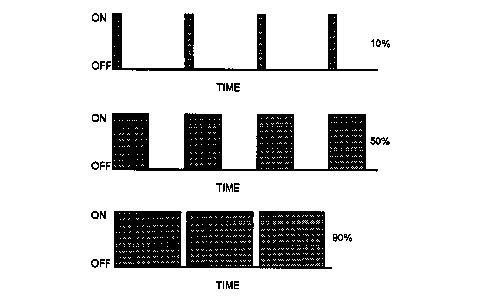
Pulse Width Modulation (PWM) – The PWM is a signal that consists of pulses that are of variable width. These pulses occur at fixed intervals. The ratio of “TIME ON” versus total “TIME OFF” can be varied. This ratio is also referred to as a duty cycle.
|
|
|
|
|
|
| Illustration 1 | g00284479 |
Rated Fuel Limit – This term indicates the maximum allowable fuel position (longest injection pulse). This position will produce rated power for this engine configuration.
Reference Voltage – The Reference Voltage is a regulated voltage and a steady voltage that is supplied by the ECM to a sensor. The reference voltage is used by the sensor to generate a signal voltage.
Remote Shutdown – The ECM disables the fuel injection signal when the Remote Shutdown Switch is closed. This causes the ECM to shut down the engine. However, the ECM remains active. The air shutoff solenoid is not activated when the remote shutdown switch is activated.
Sensor – The sensor is a device that is used to detect a change in pressure, temperature, or mechanical movement. The information that is detected is converted into an electrical signal.
Short Circuit – A short circuit is a condition that has an electrical circuit that is inadvertently connected to an undesirable point. An example of a short circuit is a wire which rubs against the engine block and this rubbing eventually wears off the wire insulation. Electrical contact with the engine block is made and a short circuit results.
Signal – The signal is a voltage or a waveform that is used in order to transmit information typically from a sensor to the ECM.
Speed Burp – A Speed Burp is a sudden, brief, unwanted change in the engine rpm.
Starting Aid Switch – This switch is used for injection of a starting aid in cold weather. An example of a starting aid is ether.
Static Timing – Static timing is the basis for correct fuel timing and valve mechanism operation. Static timing is determined by the timing ring and the alignment of the rear gear group.
Subsystem – A Subsystem that is used in this application is a part of the Electronic System that relates to a particular function. An example of a subsystem is the throttle subsystem.
Supply Voltage – The Supply Voltage is a constant voltage that is supplied to a component in order to provide electrical power that is required for the component to operate. The power may be generated by the ECM or the power may be battery voltage that is supplied by the vehicle wiring.
Suspect Parameter Number (SPN) – The SPN is a three digit code which is assigned to each component in order to identify data via the data link to the ECM. This is used on the diagnostics for the CAN data link.
System Configuration Parameters – System Configuration Parameters are Parameters that affect the power rating family or emissions.
T-Harness – The T-Harness is a test harness that is designed to connect into the vehicle harness or the engine harness. This connection allows a normal circuit operation and the connection simultaneously provides a breakout T in order to measure the signals.
Terminating Resistor – This is used to terminate the J1939 CAN Data Link. Refer to the installation procedures.
Throttle Position – The Throttle Position is the interpretation by the ECM of the signal from the Throttle Position Sensor.
Throttle Position Sensor – The throttle position sensor is an electronic sensor that is connected to the throttle lever. The throttle position sensor sends a Pulse Width Modulated Signal to the ECM.
Timing Calibration – The timing calibration is the adjustment of an electrical signal as a means of correcting the timing error between the crankshaft and the crankshaft position sensor.
Total Tattletale – The Total Tattletale is the total number of changes to all the Customer Specified Parameters that are stored in the ECM.
Trip Recorder – The Trip Recorder is an after market device that is dedicated to recording the parameters of the engine and the parameters of the operating engine during the engine service. The Trip Recorder is also used to analyze the operating habits and the logs of the operator.
Turbocharger Inlet Pressure Sensor – This analog sensor measures the pressure of the inlet air to the turbocharger compressor.
Turbocharger Outlet Pressure Sensor – This analog sensor measures the pressure of the air at the outlet of the turbocharger compressor.